
Psycho (1960) revolutionized film as we know today, and is a prime example of how the concepts of blocking, tension, and point-of-view are all used to shape a cohesive story structure. Psycho’s opening sequence is a long shot of the city; it’s a series of cuts, but is meant to be one continuous shot. Having “entered” the main character’s life, we meet Marion. In the same shot is her lover, Sam. Money is what sets the film’s chain of events in motion. Marion is given a large sum of money by a rich client of her boss, to be deposited in the bank. After she fakes being sick, we are shown a shot of the envelope full of money on her bed, which directly pans to a suitcase. The shot implies that she plans to run away with the money.

What follows is the film’s iconic driving sequence, while her car is stopped, she sees her boss, their eyes meet, the boss looks suspicious, while Marion smiles and pretends that nothing is wrong. We feel what she feels: the fear of being caught. She trades her car in, covering up her tracks. Mid-transaction, the film cuts to a shot of a police car across the road. Tension increases.
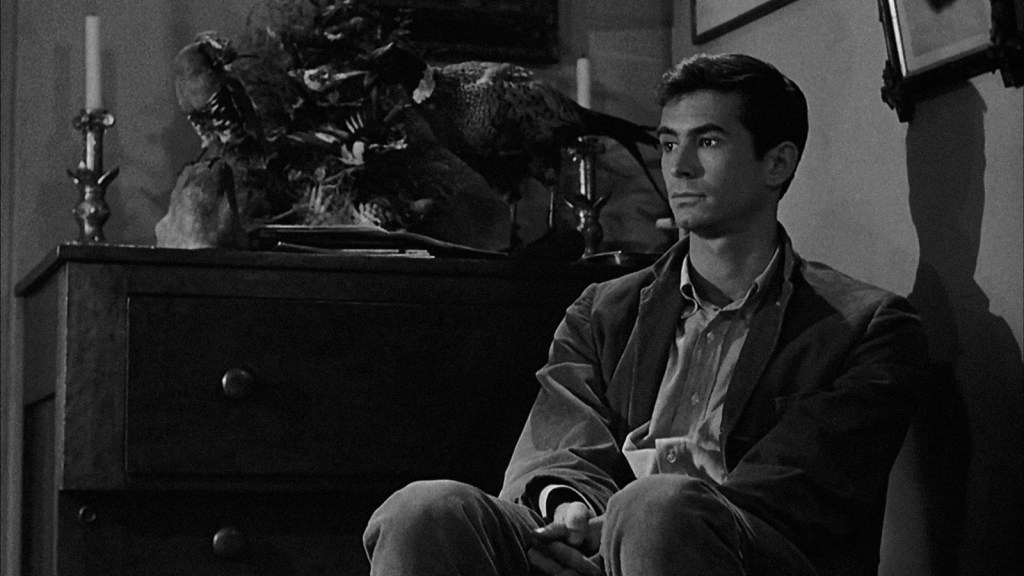
We see the heavy rain pouring onto her windshield, distorting the view outside. Comes in the Bates Motel. The bright neon sign that contrasts against the pitch-black sky sets the mood for the second act. Marion meets Norman Bates. As they talk, he describes his day-to-day life and how his mother treats him. The cuts alternate between Marion and Norman, he constantly shifts in his seat each time the camera cuts back to him. It shows his general unease and anxiety. After the exchange, Marion returns to her room while Norman stays behind. For the first time, the audience follows another character. Shortly, Norman peeps through a hole that show Marion getting undressed. The viewer joins him in his voyeurism, objectifying Marion.
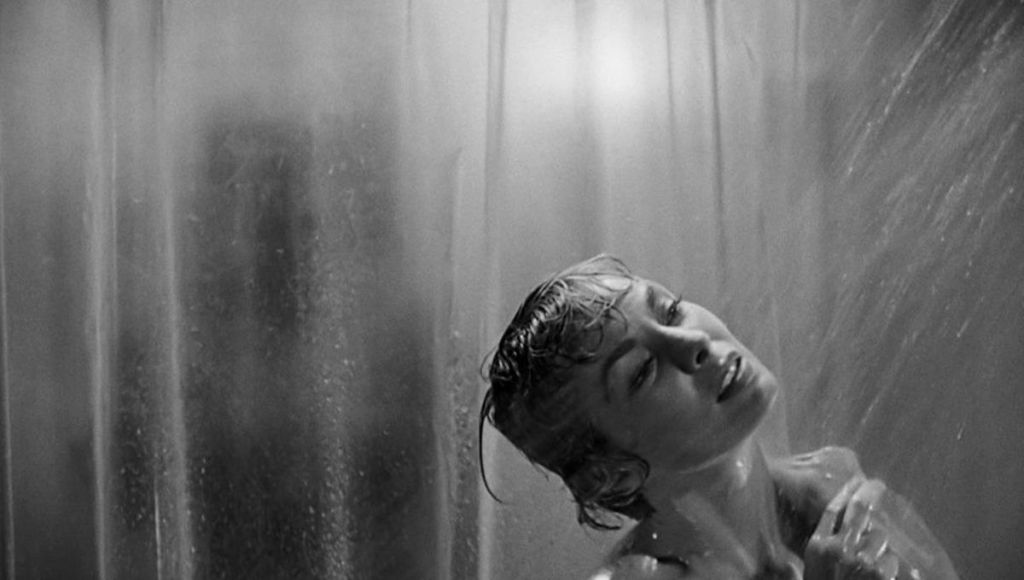

Finally, Psycho’s most iconic scene: the shower. Hitchcock plays with light and contrast in the film’s most climactic scene to amplify the horror: Mother’s silhouette through the translucent curtain, the blood splattering, Marion’s body on the bathroom tile. Afterwards, the camera slowly zooms out in a spinning motion from Marion’s eye. She is dead, and the camera chooses another subject to follow for the rest of the film: Norman.
Norman returns to the house, arguing with his mother. Him carrying her downstairs is shot from a high angle, obscuring our vision of Mother. Later on, the house is investigated by a detective, and then by Lila and Sam. Their snooping around leads to Lila’s discovery of Mother. Mother sits at the center of a dimly lit room. She is clearly the focus of the shot. The scene where she turns Mother around to reveal a lifeless skeleton, eye sockets empty, is a chilling motif that has inspired countless similar scenes, embedding the trope into much of modern cinema.
 Michaela Oconer